


Can anti-counterfeiting labels seamlessly integrate with brand design, achieving both security and aesthetics?
Release Time : 2025-12-31
In today's world, where consumers increasingly value product authenticity and brand trust, anti-counterfeiting labels have long transcended their single role as "anti-counterfeiting tools," evolving into an integral part of the brand's visual language. However, for a long time, anti-counterfeiting technology and aesthetic design have been seen as opposing forces: either jarringly pasted silver laser labels disrupt the overall packaging aesthetic, or inconspicuous, barely perceptible markings negate consumer interaction value. In fact, modern customized anti-counterfeiting labels, through the deep integration of material innovation, process integration, and creative design, have successfully broken this constraint—truly achieving the ideal state of "security without overshadowing the brand, and aesthetics without sacrificing protective power."
The key lies in the synergy between "customization" and "technological invisibility." High-end anti-counterfeiting labels no longer use generic templates but are tailored to the brand's tone, creating solutions highly coordinated with its VI (Visual Identity) system. Designers can directly integrate brand logos, primary colors, and graphic elements into the anti-counterfeiting structure. For example, using optically variable ink (OVI) to print brand logos creates color variations from different angles, forming a unique visual memory while also making it highly difficult to replicate. Alternatively, microtext technology can be used to embed brand slogans in finely detailed fonts barely visible to the naked eye, revealing them only under a magnifying glass, cleverly balancing decorative appeal with professional anti-counterfeiting functionality.
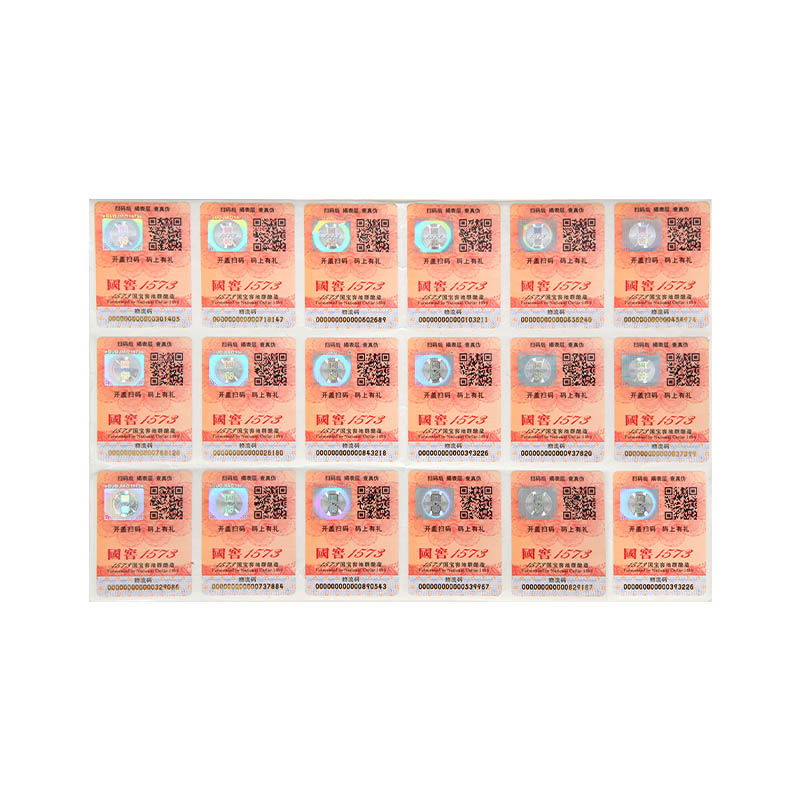
Furthermore, many anti-counterfeiting technologies possess aesthetic potential. Holographic laser images are no longer limited to monotonous rainbow effects but can be customized into brand-specific dynamic images, 3D embossing, or gradient textures, becoming the "visual focal point" on packaging. Temperature-sensitive or photochromic inks can reveal hidden information under specific conditions, providing consumers with a sense of exploration and enhancing the interactive experience. High-transparency laminated anti-counterfeiting labels can even be "invisible" to the bottle or box, revealing verification features only under specific lighting or angles, truly achieving "invisible security."
Meanwhile, advancements in printing technology are blurring the lines between anti-counterfeiting and design. Digital printing supports small-batch, multi-version personalized label production, allowing each batch and even each individual item to have a unique code and pattern combination. This enhances anti-counterfeiting levels and provides creative space for marketing campaigns such as limited editions and collaborations. Traditional packaging techniques such as hot stamping, embossing, and spot UV coating can also be combined with anti-counterfeiting elements, improving tactile appeal and layering while increasing the difficulty of counterfeiting.
More importantly, modern anti-counterfeiting labels emphasize a "user-friendly" verification experience. Aesthetically pleasing designs encourage consumers to actively verify—a sophisticated QR code or an elegant color-changing pattern will stimulate users' interest in scanning or observing. This "willingness to look and enjoy verification" is far more effective than mandatory anti-counterfeiting prompts. When the verification process itself becomes part of the brand experience, anti-counterfeiting shifts from passive defense to proactive communication.
Of course, security remains the bottom line. Even with highly customized appearances, the core anti-counterfeiting layer still contains multiple invisible technologies: such as nanoscale microstructures, fluorescent fibers, and chemical fingerprints, which are only identifiable by regulatory authorities or the company's backend system. This dual-layered architecture, combining aesthetic appeal with internal security, ensures that even if the appearance is imitated, its underlying security logic cannot be replicated.
In conclusion, today's customized anti-counterfeiting labels are no longer just "patches" on packaging, but rather "intelligent skins" in a brand strategy—they can elegantly convey brand value while providing an invisible shield to protect product authenticity. In the trust economy, a safe and aesthetically pleasing anti-counterfeiting label not only deters counterfeits but also wins hearts and minds. It proves that true protection doesn't need to be ostentatious; ultimate security can also be pleasing to the eye.
The key lies in the synergy between "customization" and "technological invisibility." High-end anti-counterfeiting labels no longer use generic templates but are tailored to the brand's tone, creating solutions highly coordinated with its VI (Visual Identity) system. Designers can directly integrate brand logos, primary colors, and graphic elements into the anti-counterfeiting structure. For example, using optically variable ink (OVI) to print brand logos creates color variations from different angles, forming a unique visual memory while also making it highly difficult to replicate. Alternatively, microtext technology can be used to embed brand slogans in finely detailed fonts barely visible to the naked eye, revealing them only under a magnifying glass, cleverly balancing decorative appeal with professional anti-counterfeiting functionality.
Furthermore, many anti-counterfeiting technologies possess aesthetic potential. Holographic laser images are no longer limited to monotonous rainbow effects but can be customized into brand-specific dynamic images, 3D embossing, or gradient textures, becoming the "visual focal point" on packaging. Temperature-sensitive or photochromic inks can reveal hidden information under specific conditions, providing consumers with a sense of exploration and enhancing the interactive experience. High-transparency laminated anti-counterfeiting labels can even be "invisible" to the bottle or box, revealing verification features only under specific lighting or angles, truly achieving "invisible security."
Meanwhile, advancements in printing technology are blurring the lines between anti-counterfeiting and design. Digital printing supports small-batch, multi-version personalized label production, allowing each batch and even each individual item to have a unique code and pattern combination. This enhances anti-counterfeiting levels and provides creative space for marketing campaigns such as limited editions and collaborations. Traditional packaging techniques such as hot stamping, embossing, and spot UV coating can also be combined with anti-counterfeiting elements, improving tactile appeal and layering while increasing the difficulty of counterfeiting.
More importantly, modern anti-counterfeiting labels emphasize a "user-friendly" verification experience. Aesthetically pleasing designs encourage consumers to actively verify—a sophisticated QR code or an elegant color-changing pattern will stimulate users' interest in scanning or observing. This "willingness to look and enjoy verification" is far more effective than mandatory anti-counterfeiting prompts. When the verification process itself becomes part of the brand experience, anti-counterfeiting shifts from passive defense to proactive communication.
Of course, security remains the bottom line. Even with highly customized appearances, the core anti-counterfeiting layer still contains multiple invisible technologies: such as nanoscale microstructures, fluorescent fibers, and chemical fingerprints, which are only identifiable by regulatory authorities or the company's backend system. This dual-layered architecture, combining aesthetic appeal with internal security, ensures that even if the appearance is imitated, its underlying security logic cannot be replicated.
In conclusion, today's customized anti-counterfeiting labels are no longer just "patches" on packaging, but rather "intelligent skins" in a brand strategy—they can elegantly convey brand value while providing an invisible shield to protect product authenticity. In the trust economy, a safe and aesthetically pleasing anti-counterfeiting label not only deters counterfeits but also wins hearts and minds. It proves that true protection doesn't need to be ostentatious; ultimate security can also be pleasing to the eye.