


How can the internal cushioning design of paper food boxes be optimized for different types of food?
Release Time : 2026-03-05
The internal cushioning design of paper food boxes is a crucial element in ensuring food safety during transportation, storage, and sales. Its core lies in achieving a balance between cushioning performance, cost, and environmental friendliness through structural innovation, material selection, and process optimization, based on the different physical characteristics, fragility, and packaging requirements of various foods. Different foods have significantly different requirements for cushioning design. For example, fragile foods require primary impact protection, liquid foods require leak prevention, and fresh foods need to balance pressure resistance and freshness preservation. Therefore, design strategies must be tailored accordingly.
For fragile foods such as pastries, biscuits, or sauces in ceramic packaging, the primary goal of cushioning design is to absorb the vibration and impact energy during transportation. Corrugated cardboard can be used as the main cushioning material in paper packaging boxes. Increasing the number of cardboard layers or adjusting the corrugated shape (such as U-shaped or V-shaped) can improve compressive strength. Simultaneously, honeycomb or corrugated paper pads can be designed inside the box, utilizing their three-dimensional structure to disperse impact force and prevent food from directly contacting the rigid packaging walls. For example, embedding a foldable paper support inside a cake box can both secure the cake's position and absorb collision energy through multiple layers of cardboard, reducing the risk of breakage. Packaging for liquid foods such as milk, juice, or condiments requires extra consideration for leak-proof and airtight sealing. Paper packaging boxes often employ composite material structures, where a waterproof coating or composite plastic film is applied to the surface of the paper substrate to form a barrier layer preventing liquid penetration. For liquid foods that require heating, an independent inner plastic bag can be designed inside the box, with the outer paper packaging securing the inner bag's position through a tightly fitting inner lining structure to prevent loosening due to shaking. Furthermore, adding paper clips or magnetic closures at the connection between the lid and the box body can further enhance sealing and prevent liquid spillage during transportation.
Packaging for fresh foods such as fruits, meat, or seafood needs to balance pressure resistance and freshness preservation. Paper packaging boxes can achieve functional partitioning through layered designs. For example, a highly absorbent paper pad can be placed at the bottom to absorb condensation, a perforated paper divider can be placed in the middle layer to separate different food items, and a rigid cardboard layer can be used to reinforce the box structure at the top. For perishable foods, biodegradable ice packs or phase change materials can be embedded inside the packaging. Temperature fluctuations can be controlled through the paper wrapping layer, extending shelf life. Simultaneously, using perforated or foldable cardboard box structures reduces material usage and allows for air circulation, mitigating the risk of spoilage.
Powdered foods such as coffee powder, milk powder, or spices require packaging to prevent clumping and leakage. Paper packaging boxes can achieve a tight seal through optimized opening design, such as using screw-top lids or flip-top structures with silicone sealing rings, ensuring a seamless closure. Paper dividers or individual packets can be added inside the box to separate the powder into smaller portions, reducing dust scattering caused by shaking. Furthermore, adding a moisture-proof coating to the outer layer of the packaging box and using food-grade aluminum foil composite paper for the inner layer effectively blocks moisture and prevents the powder from absorbing moisture and clumping.
Heavy foods such as canned goods, glass-bottled foods, or large-package snacks require reinforced overall structural strength. Paper packaging boxes can use high-grammage kraft paperboard or double-layer corrugated cardboard as the main material, increasing the cardboard thickness or adding transverse reinforcing ribs to improve compression resistance. Adjustable paper supports are designed inside the box to fix the position according to the food size, preventing packaging deformation due to a shift in the center of gravity during transportation. For large-sized packaging, paper corner protectors can be added around the box to distribute edge pressure and prevent breakage through localized reinforcement.
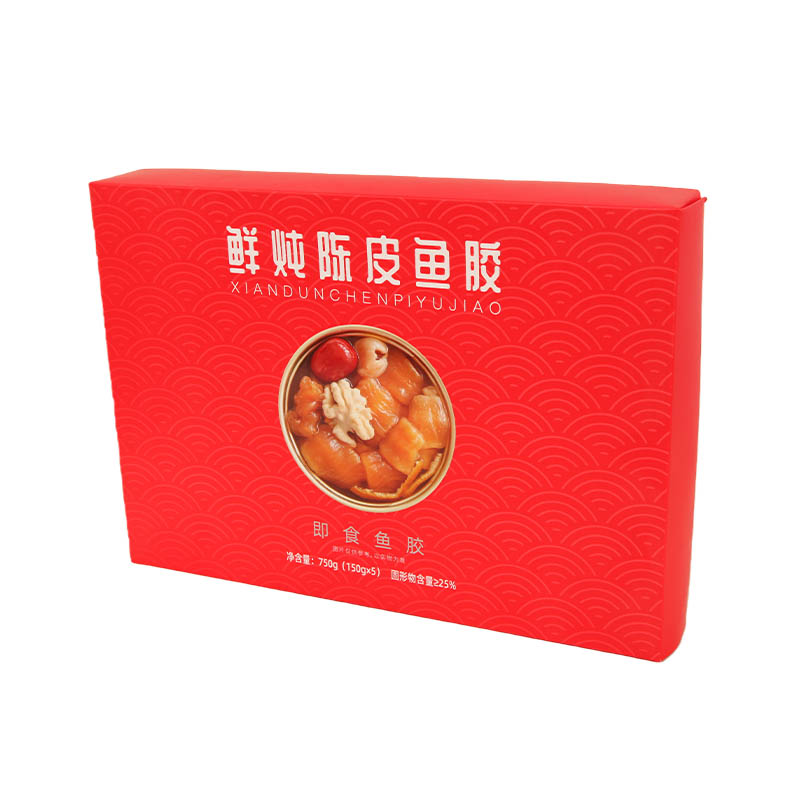
Packaging for multi-item food combinations, such as gift boxes or sets, requires a coordinated internal space layout. Paper packaging boxes can be flexibly assembled through modular design. For example, the box can be divided into multiple independent compartments, each with a custom-made paper tray according to the food shape, both fixing the food's position and absorbing impact through the gaps between compartments. For irregularly shaped foods, thermoformed paper liners can be used, with grooves molded to perfectly fit the food's contours for precise fixation. Furthermore, adding paper partitions or cushioning pads to combined packaging can prevent damage caused by collisions between different food items.
The internal cushioning design of paper food boxes needs to comprehensively consider food characteristics, transportation environment, and user experience, achieving a balance between functionality and sustainability through material innovation and structural optimization. As consumers become increasingly focused on environmental protection and safety, future cushioning designs will increasingly favor biodegradable materials, intelligent structures, and lightweight designs, ensuring food quality while driving the packaging industry towards a green and low-carbon transformation.